
Counter-terrorism commando force National Security Guard has been deployed at the IAF Srinagar and Jammu stations to provide anti-drone cover to these vital installations, the force's director general M A Ganapathy said on Saturday.
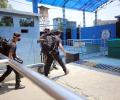
Investigators scanned CCTV footage, including from cameras installed on the boundary walls of the airport, in an effort to determine from where the drones came. However, all the CCTV cameras focused on the roadside, the officials said.
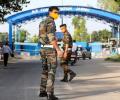
Investigators are also examining the possible use of drones to drop the explosives at the airport that has various assets of the IAF, they said.
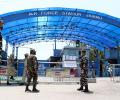
In what is the first time Pakistan-based terrorists have used drones to strike vital installations, two bombs were dropped at the Indian Air Force station in Jammu airport in the early hours of Sunday, officials said.

A first information report (FIR) was registered Sunday under the Unlawful Activities (Prevention) Act after two explosives-laden drones crashed into the Indian Air Force station at Jammu airport, officials said, while indicating that the case is likely to be taken over by the terror probe agency National Investigation Agency.

The CBI arrested Shafat Ahmed Shangloo, an absconder carrying a Rs 10 lakh reward, in connection with the 1989 kidnapping of Rubaiyya Sayeed. He is allegedly part of a conspiracy hatched by the banned JKLF.
The IED that pierced the rooftop of one of the IAF buildings at the Jammu airport carried less than one kg of RDX and a cocktail of other chemicals whereas the one that was dropped on the ground contained a little over one kg of the deadly explosives along with some ball bearings.
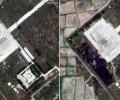
The attacks against the Pakistani air force have taken them at least five years back and caused great damage to them and their Chinese and Turkish inventory of weapons.

In a viral video uploaded to a YouTube channel on Tuesday, JeM commander Ilyas Kashmiri can be heard fuming over the Indian attack that killed the family members of Azhar and also bragging about fighting in neighbouring countries for Pakistan.
"Our house is gone, household goods have perished and all our animals killed. We did not have anything to eat," said Chamail Singh of Rajouri district while showering praise on Indian Air Force for air-dropping food items and other relief material.
'But that was not our aim. Our objective was already achieved.'

The Indian Air Force conducted precision strikes on terror hideouts in Pakistan, targeting a Jaish-e-Mohammad communication network housed in a primary health centre in Tehra Kalan village. The communication setup was essential for planning and coordinating activities with infiltrated terrorists in Jammu and Kashmir. The strikes aim to dismantle the communication network and hinder the terrorists' ability to operate.
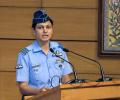
Wing Commander Vyomika Singh, an accomplished helicopter pilot in the Indian Air Force, was chosen to brief the nation about India's 'Operation Sindoor' strikes on Pakistan. She has flown a variety of aircraft and taken part in rescue operations in extreme conditions. Vyomika, who has logged over 2,500 flying hours, has operated helicopters across challenging terrains, from the high-altitude sectors in Jammu and Kashmir to the remote areas in the Northeast. She led a rescue operation in Arunachal Pradesh in 2020, flying in extreme conditions to evacuate civilians.

The Air Chief revealed information about India's damage to Pakistan's defence capabilities while addressing an event at the Hal Management Academy in Bengaluru on Saturday.
India's robust air defence system effectively thwarted Pakistani attempts to target Indian installations.
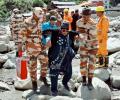
Glimpses from India and around the world that will make you smile and cry.
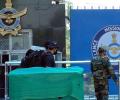
Two Indian Air Force personnel, who suffered minor injuries in two low-intensity explosions that took place at the Jammu Air Force Station earlier on Sunday, are under observation and doing fine, informed IAF officials.
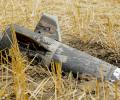
Debris resembling parts of a missile was found in a field in Hoshiarpur, Punjab, while metal parts of unidentified objects were discovered at two locations in Bathinda, sparking panic among locals. The incidents come after India successfully thwarted Pakistan's attempts to target military installations with drones and missiles across the country.

Additional Director General of Police, Jammu, Anand Jain and senior officers of the Army and intelligence agencies visited the ambush spot in the Surankote area. The Army also conducted aerial surveillance using a helicopter, they said.
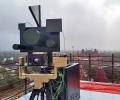
The IAF will deploy these systems at different airbases and has asked vendors to provide a multi-sensor, multi-kill solution to enforce effectively.
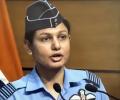
Wing Commander Vyomika Singh's role at the press briefing for Operation Sindoor is consistent with her experience as a helicopter pilot in Jammu and Kashmir during the course of her career.
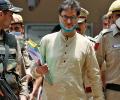
Four IAF personnel, including a squadron leader, were killed and 22 injured on January 25, 1990, at Rawalpora on the outskirts of Srinagar.

Here is a chronology of terror incidents in the region this year.

The Indian Air Force on September 22 flew fighter jets as part of rehearsals for the air show to be held at Air Force Station Jammu.
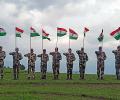
With respect and gratitude we honour the memory of soldiers who sacrificed their lives in Operation Sindoor.
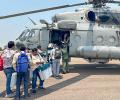
"The IAF played a vital role in five of the seven phases of the general elections, flying over 1,000 hours in over 1,750 sorties," it said.
Jaish-e-Mohammad chief Maulana Masood Azhar has acknowledged that 10 members of his family and four close associates were killed in India's missile attack on the outfit's headquarters in Bahawalpur. The statement attributed to Azhar said those killed included his elder sister and her husband, a nephew and his wife, another niece, and five children from his extended family. The attack also claimed the lives of one of Azhar's close associates and his mother, along with two other close companions.

Over 100 terrorists, including high-value targets such as Yusuf Azhar, Abdul Malik Rauf and Mudasir Ahmed, were eliminated during Operation Sindoor on May 7, the Indian military said on Sunday.
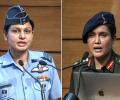
India conducted precision strikes on nine terror targets in Pakistan and Pakistan-Occupied Kashmir, targeting terrorist infrastructure to deter further attacks. The operation, codenamed 'Operation Sindoor', was detailed by two women military officers, Col Sofiya Qureshi and Wing Commander Vyomika Singh, at a press briefing in New Delhi. The officers highlighted the precise nature of the strikes, emphasizing the use of "niche technology weapons" to ensure no collateral damage. The briefing showcased India's military prowess and the growing role of women in the armed forces.
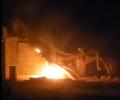
The nine targets struck under 'Operation Sindoor', four in Pakistan and five in Pakistan-occupied-Kashmir, were chosen by the IAF after receiving intelligence inputs about terror camps operating under the guise of health centres to evade detection at these sites, officials said on Wednesday.
The Bahawalpur centre is notorious for hoarding arms and ammunition left behind by the NATO forces in Afghanistan, the officials said.
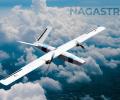
The foremost lesson for India today is to beef up its air defence to cater for multiple drone attacks. As seen in Operation Sindoor, we have come a long way, but there's room for getting better. We must develop a robust and almost impregnable air cover over ourselves, asserts IAF veteran Air Commodore Nitin Sathe (retd).
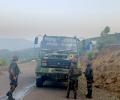
The attack took place near Shashidhar in the evening when the vehicles were moving towards Sanai Top in the district's Surankote area.
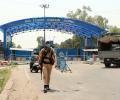
Drones have added a new dimension to security threats from terror groups and investigations into the attack on the Jammu IAF station last month show the involvement of "non-State actors" supported by State actors such as the ordnance factory of Pakistan, Jammu and Kashmir DGP Dilbag Singh said on Tuesday.

Coming to the rescue of stranded passengers in Jammu and Ladakh regions, India Air Force on Tuesday airlifted 203 stranded people from Leh town to Jammu.
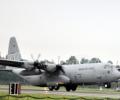
The newly-acquired C-130J aircraft of the Indian Air Force fleet, famously known as 'Super Hercules' made a maiden flight at the air force station at Jammu on September 27, a defence statement said.
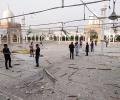
'The Pakistani State has to realise that the pigeons have come home to roost.'
With hundreds of people left stranded due to inclement weather, the Indian Air Force on Saturday launched fresh operation by ferrying 550 passengers, including 300 civilians between the two capital cities.
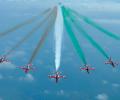
The Indian Air Force's Suryakiran aerobatic team dazzles the skies during Phase 2 of Exercise Tarang Shakti 24 with their mesmerising aerial display in Jodhpur.
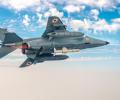
India's precision strikes using an array of weapon systems and missiles on eight key installations ranging from air defence systems to radar sites and command centres of the Pakistani military forced Islamabad to urge New Delhi to end the hostilities, the sources said.
 © 2026 Rediff.com - Advertise with us - Disclaimer - Privacy Policy - Sitemap - Feedback - About us - Terms of use - Grievances